

Introducing Spotsavr: Extending Spotbookr Intelligence to the Point of Transaction
At Spotbookr, we’ve spent years building systems that answer a deceptively simple question: what is actually working across digital commerce?
Answering that requires more than surface-level data. It involves ingesting structured signals from platform APIs, normalizing them at scale, and identifying patterns across pricing, creative strategy, and conversion behavior. The result is an intelligence layer that helps operators understand not just what is happening, but where the underlying momentum is shifting in real time.
Today, we’re introducing Spotsavr, a Chrome extension that brings that same philosophy out of the dashboard and into the transaction itself.
This is the first time Spotbookr’s intelligence stack has been applied directly at the point of purchase.
From Observation to Intervention
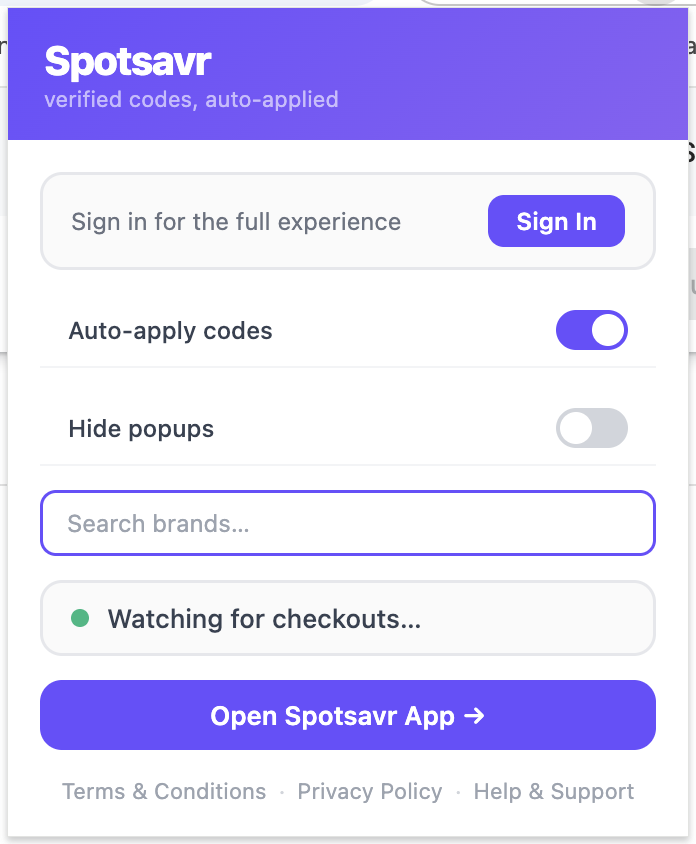 Until now, Spotbookr has primarily operated as an observational system. It surfaces signals, highlights trends, and enables better decisions upstream in the funnel. That alone is valuable, but it leaves a structural gap between insight and execution.
Spotsavr is designed to close that gap.
When a user reaches checkout, the system evaluates the available discount landscape in real time and intervenes only when there is a clear opportunity to improve the outcome. It does not ask for input, and it does not expose unnecessary controls. The system simply acts when action is justified.
This represents a shift toward software that participates in results, rather than just informing them.
Designing for Deterministic Outcomes
A core constraint in building Spotsavr was eliminating user effort entirely.
Traditional savings tools rely on interaction—clicking buttons, selecting offers, or manually testing codes. That interaction introduces inconsistency and often degrades the final outcome.
Spotsavr removes that layer entirely.
It runs as a passive process, detecting checkout states and executing automatically. There is no configuration surface, no account requirement, and no dependency on user behavior. Given the same inputs, the system is designed to produce the same optimized result every time.
Evaluating Discounts as Expected Value
Discount codes are not binary. Their success depends on timing, context, cart composition, and platform-specific behavior.
Spotsavr treats each code as a probabilistic outcome.
Available codes are ranked based on expected value, incorporating historical success rates, observed savings, and contextual relevance to the active session. Execution happens only after this evaluation layer determines the highest-likelihood, highest-impact option.
This is consistent with how Spotbookr models performance more broadly: not as isolated events, but as distributions of possible outcomes.
How Spotsavr Differs from Legacy Savings Tools
Tools like Honey, Rakuten, and Capital One Shopping were built around aggregation. They collect large volumes of offers, surface them to users, and rely on interaction to determine which one applies.
That model has limitations.
First, it assumes the user will complete the optimization process themselves—testing codes, selecting offers, and interpreting results. Second, it treats all opportunities as roughly equivalent, without deeply ranking them based on expected performance.
Spotsavr takes a fundamentally different approach.
It does not present options. It resolves them.
Instead of acting as a marketplace of discounts, it functions as an execution engine. The system evaluates all available inputs, ranks them using outcome-based logic, and applies only the highest-value result. There is no user decision layer, and no reliance on static or user-submitted datasets.
More importantly, Spotsavr is not an isolated product. It is connected to a broader intelligence system that continuously improves how those decisions are made.
Operating Across a Fragmented Commerce Layer

Modern e-commerce is highly fragmented, spanning platforms like Shopify, WooCommerce, BigCommerce, and a wide range of custom checkout implementations.
Spotsavr is designed to operate at the interface layer rather than relying on deep platform integrations. This allows it to remain platform-agnostic while maintaining consistent execution logic across environments.
The complexity of these systems is abstracted away. From the user’s perspective, the behavior is uniform.
Closing the Loop: From Consumer Behavior to Market Intelligence
The most important aspect of Spotsavr is not just what it does at checkout, but what it enables upstream.
Every interaction becomes a data point.
By observing real-world checkout behavior—what codes succeed, how pricing reacts, where discounts meaningfully change conversion outcomes—Spotsavr generates a continuous stream of high-signal consumer data. This data feeds directly back into the Spotbookr system.
This creates a feedback loop:
- Consumer behavior informs pricing and discount effectiveness
- Discount effectiveness informs conversion modeling
- Conversion modeling informs ad strategy, creative direction, and media allocation
In other words, Spotsavr transforms passive observation into an active data pipeline.
Instead of relying solely on platform-reported metrics, Spotbookr can now incorporate real transaction-layer signals into its intelligence models. This allows for more accurate optimization of advertising funnels, more responsive media strategies, and a clearer understanding of what actually drives outcomes in live environments.
A Natural Extension of the Spotbookr System
Spotsavr is not a departure from Spotbookr’s core thesis. It is a continuation of it.
The same infrastructure used to analyze macro-level trends across digital advertising is now influencing micro-level outcomes at the point of transaction. Insight and execution are no longer separate layers—they are part of the same system.
Available Now
Spotsavr is now available on the Chrome Web Store.
Once installed, it operates continuously in the background, activating only when there is a measurable opportunity to improve a transaction outcome.
Free · No account required · Chrome desktop