
What Is the Difference Between an Estimate, a Quote and an Invoice?
An estimate is your best guess at the price before the work starts, and it can change. A quote is a fixed price you commit to for a defined piece of work, usually valid for a set time. An invoice is the request for payment, sent once the price is agreed or the work is done.
In practice
| When you send it | Can the price change? | What it asks for | |
|---|---|---|---|
| Estimate | Before the work | Yes, within reason, and you should say so | Agreement to go ahead |
| Quote | Before the work | No, not for the work described | Acceptance |
| Invoice | When payment is due | No | Payment, by a date |
Many businesses use "estimate" and "quote" to mean the same thing. What matters is that your customer knows whether the number is firm. Say it plainly on the document: "This price holds for 30 days" or "Final price may vary by up to 10% once we see the site."
When to send each one
- Before the work: an estimate or quote, with what is included, what is not, and how long the price holds.
- When the customer says yes: keep a record of the acceptance. A signed or clicked acceptance saves arguments later.
- When payment is due: the invoice, with a due date and the ways to pay. That can be at the start (a deposit or payment in advance), at milestones, or at the end.
What to put on each document
An estimate or quote should include: - Your business name, contact details and the date - The customer's name and the job or project it is for - A line for each part of the work, with quantity and price - Tax, if you charge it, and the total - What is not included (materials, travel, extra visits) - How long the price holds ("valid for 30 days") - Payment terms: deposit, milestones, when the balance is due - How to accept
An invoice should include: - The word "Invoice" and a unique invoice number - The issue date and the due date - The same lines and prices that were agreed, plus any agreed changes - Tax and the total, and anything already paid - How to pay, with a link if customers can pay online - Your tax number, if your country requires it
Examples by type of business
- A contractor sends an estimate after a site visit ("Final price may vary by up to 10% once walls are opened"), then invoices a deposit on acceptance and the balance on completion.
- A web designer sends a fixed quote for a defined scope, and invoices half up front and half at launch. Anything outside the scope gets its own quote.
- A consultant quotes a monthly retainer and invoices at the start of each month.
- A salon or clinic rarely sends estimates at all: the price list is the quote, and payment is taken at the appointment.
Common mistakes
- No expiry date on the estimate. Prices change; say how long yours holds.
- Vague lines such as "Work done: $2,400". Customers question lumps; they accept itemised work.
- Invoicing something different from what was accepted, without explaining the change.
- No due date on the invoice. "Payable on receipt" or a date: say which.
- Retyping the estimate into the invoice by hand and making a mistake.
Pricing an estimate so it holds
- Break the work into parts you can price separately: labour, materials, travel, subcontractors.
- Use your own history. What did the last few similar jobs actually take?
- Add a contingency for the unknown, often 10–15%, and decide whether to show it as a line or include it in your prices.
- List exclusions plainly: "Does not include painting or skip hire".
- Set a validity period short enough that material prices will not move much.
- State the conditions that would change the price: "If asbestos is found, work stops and we will quote separately."
A clear estimate sometimes loses to a cheaper vague one, but it rarely turns into a dispute.
A worked example
James is an electrician. A homeowner asks him to rewire a kitchen. After a visit he sends an estimate for $3,400 with a note: "Final price may vary by up to 10% once walls are opened. Valid for 30 days. 30% deposit on acceptance."
The homeowner accepts online. James sends a deposit invoice for $1,020 the same day. When the walls are opened he finds an old junction box that must be replaced; he explains it, the homeowner agrees, and he adds it as a separate $180 line.
When the work is done, the final invoice shows the original lines, the agreed extra, the deposit already paid, and a balance of $2,560 due in 7 days, with a link to pay by card. There is nothing to argue about, because every number traces back to something agreed.
Quick checklist
- The estimate says whether the price is fixed or may vary, and by how much
- It says how long the price holds and when payment is due
- The customer's acceptance is recorded
- Changes are agreed in writing before the work
- The invoice matches the accepted estimate plus agreed changes
- The invoice has a number, a due date and a way to pay
Key terms
- Estimate: an approximate price for work, given before it starts, which may change within limits you state.
- Quote: a fixed price for a defined piece of work, usually valid for a set period.
- Invoice: a request for payment, with a number, a due date and how to pay.
- Pro forma invoice: a preliminary invoice sent before work or delivery, often to request payment in advance.
How to do it in Spotbookr
Under Invoicing, Estimates write an estimate with lines, discounts and notes, and send it. Your customer opens a link and accepts or declines online.
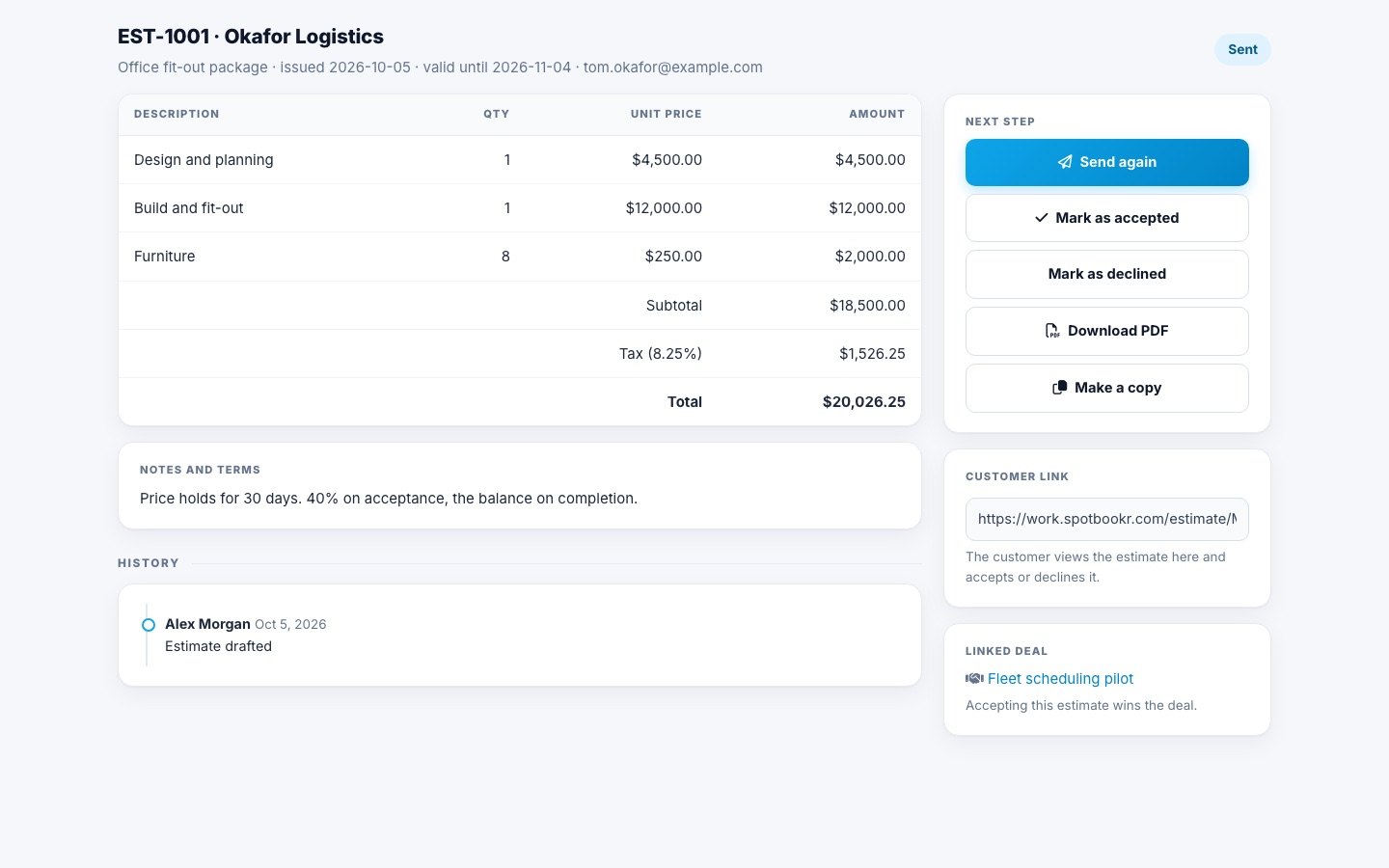
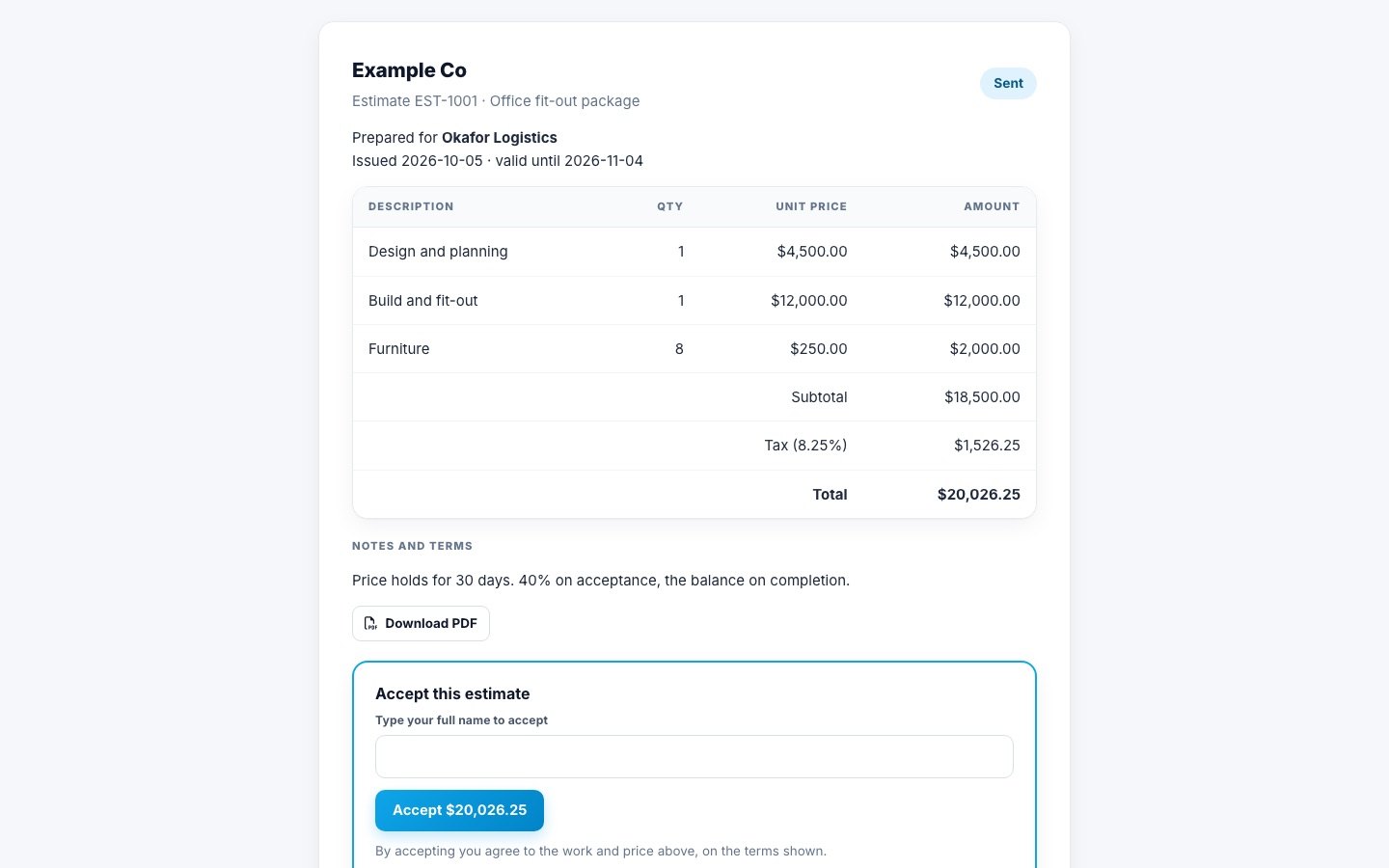
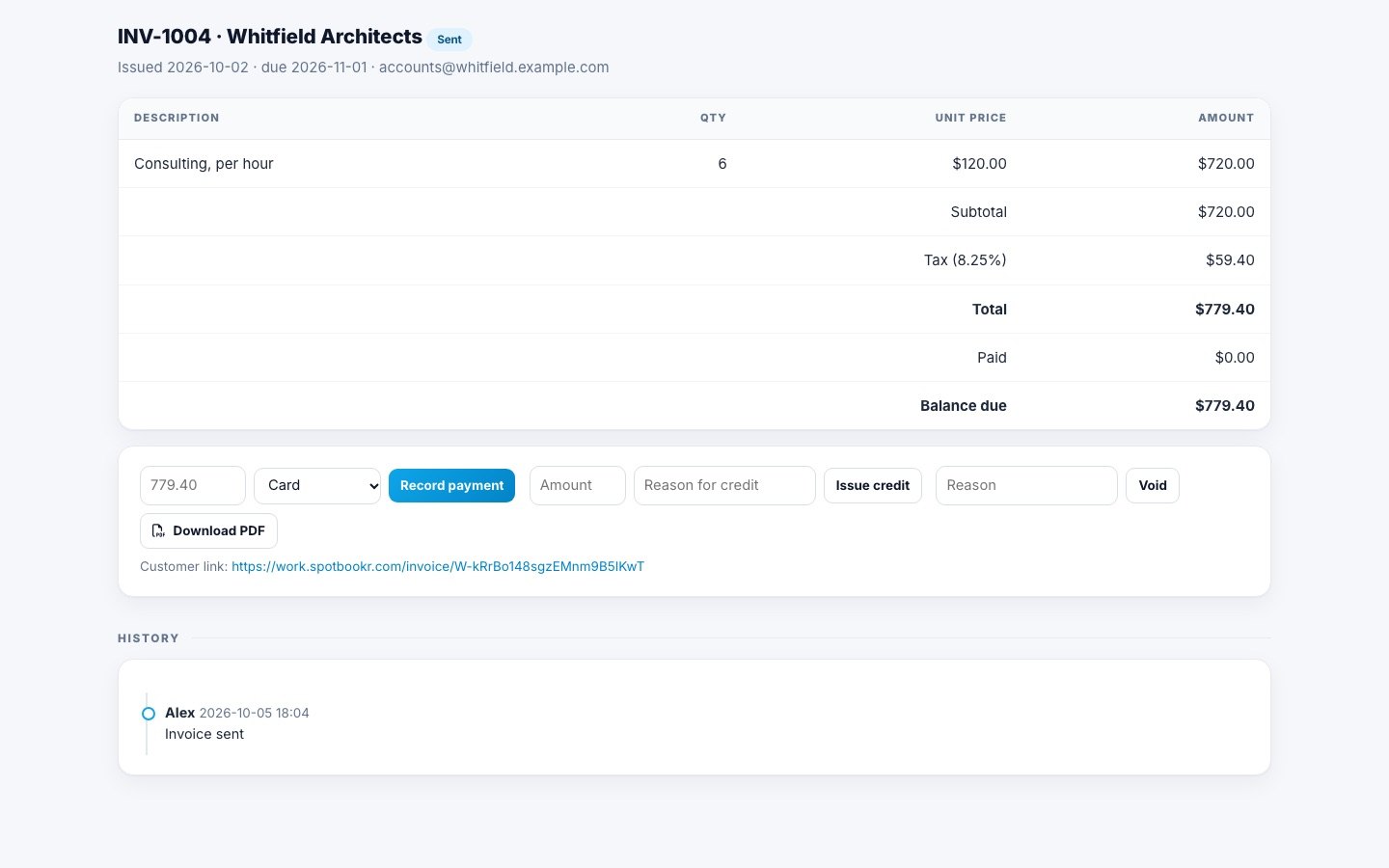
When the customer accepts, the estimate becomes a draft invoice with the same lines, so nothing is retyped. Send it when you are ready; the customer gets a link to view it, download a PDF and, if you take cards, pay.
Related questions
Is an estimate legally binding?
Usually less than a quote, because it is an approximation. But once a customer accepts it, the accepted terms can form an agreement. Write what is included and how much the price may change.
Should I invoice before or after the work?
Both are common. Invoicing at the start (or taking a deposit) protects you on big or custom jobs; invoicing at the end suits small, quick work with customers you trust.
What is a pro forma invoice?
A preliminary invoice sent before the work or delivery, showing what the final invoice will be. It is often used to request payment in advance.
Do I need to send an estimate for every job?
Not for small, fixed-price work your customers already know the price of. For anything custom, large or open to interpretation, a written estimate prevents disagreements later.
Can I change the price after the customer accepts an estimate?
Only for work that was not in the estimate, or under conditions you wrote in it. Agree the change in writing before doing the work, then show it on the invoice.
What is a purchase order?
A document a business customer sends to confirm they are buying what you quoted. Some companies will not pay an invoice unless it shows their purchase order number, so ask for it up front.
Should an estimate include tax?
Yes, show tax separately so the customer sees the full amount they will pay.
The Help Center has the details: Estimates and invoices. You can also try Spotbookr with sample data.